
Sight Words Worksheets PDF: A Comprehensive Guide
Sight words worksheets PDF are invaluable tools for educators and parents, fostering early literacy skills through focused practice and engaging activities.

These printable resources accelerate reading fluency, building a strong foundation for academic success in young learners, utilizing frequently encountered words.
What are Sight Words?
Sight words, also known as high-frequency words, are commonly used words that children are encouraged to memorize as a whole, rather than sounding them out. These words – like “the,” “and,” “a,” “I,” “to,” and “is” – appear frequently in reading materials, and recognizing them instantly boosts reading speed and comprehension.
Essentially, they become automatically recognized, freeing up cognitive resources for decoding more complex words. Edward William Dolch identified 220 “sight words” in 1936, believing they comprised up to 75% of the words found in children’s books.
Mastering these words is crucial for building reading confidence and fluency, especially in the early stages of literacy development. Sight word worksheets PDF are designed to aid in this memorization process through repetition and varied practice.
Why Use Sight Words Worksheets?
Sight words worksheets PDF offer a structured and effective approach to building foundational reading skills. They provide targeted practice, reinforcing recognition of high-frequency words essential for fluent reading. Utilizing these worksheets helps children move beyond decoding and towards comprehension, as they spend less effort on individual word identification.
The printable format allows for convenient use at home or in the classroom, offering flexibility for learning. Worksheets cater to various learning styles through diverse activities – from simple recognition tasks to sentence building.
Consistent practice with sight words worksheets builds confidence and accelerates reading progress, setting children up for success in their educational journey. They are a valuable supplement to traditional reading instruction.

The Dolch Sight Word List
The Dolch Sight Word List, comprising 220 frequently used words, is a cornerstone of early reading instruction, aiding fluency and comprehension skills.
History of the Dolch List (Edward William Dolch)
Edward William Dolch, Ph.D., a prominent figure in reading education, meticulously compiled the now-famous Dolch Sight Word List in 1936. His research centered on identifying the most frequently occurring words in children’s literature. Dolch believed that mastering these high-frequency words – those appearing repeatedly in texts – was crucial for developing reading speed and comprehension.
He advocated for a “whole word” reading approach, emphasizing recognition of words as complete units rather than relying solely on phonics. Dolch’s analysis revealed that a relatively small number of words accounted for a significant percentage of the text children encounter. This discovery led to the creation of his list, designed to provide targeted practice for young readers. His work aimed to streamline the learning process, enabling children to decode texts more efficiently and enjoy reading with greater confidence.
The list continues to be a foundational resource in early literacy education, influencing the development of countless sight words worksheets PDF and reading programs.
Dolch Word List Levels: Pre-Primer to Grade Three
The Dolch Sight Word List is strategically organized into levels, progressing in difficulty from Pre-Primer to Grade Three, facilitating a structured learning approach. Each level introduces a new set of high-frequency words appropriate for a child’s developing reading skills.
Pre-Primer introduces the most basic words, like “a,” “I,” and “see,” ideal for beginning readers. Primer builds upon this foundation with words like “and,” “away,” and “for.” Grade One expands the vocabulary further, including “he,” “she,” and “was.” Grade Two introduces more complex words such as “find,” “grow,” and “learn.” Finally, Grade Three challenges students with words like “begin,” “carry,” and “different.”
This leveled system allows educators and parents to tailor sight words worksheets PDF to a child’s specific reading level, ensuring appropriate challenge and fostering success.
Complete Dolch Word List Breakdown

The Dolch Sight Word List comprises 220 frequently used words, categorized by grade level for effective learning. Utilizing sight words worksheets PDF, students systematically master these essential terms.
The Pre-Primer list includes foundational words like “a,” “I,” “is,” and “to.” The Primer list expands with “and,” “away,” “for,” and “look.” Grade One introduces “he,” “she,” “was,” and “you.” Grade Two builds upon this with “find,” “grow,” “learn,” and “talk.” Finally, Grade Three includes “begin,” “carry,” “different,” and “sudden.”
These lists, when incorporated into targeted worksheets, enable children to recognize words instantly, improving reading fluency and comprehension. Consistent practice with these sight words worksheets PDF is key to building a strong reading foundation.
Pre-Primer Dolch Words
The Pre-Primer Dolch Sight Word List introduces the very first words young learners encounter, forming the bedrock of reading fluency. These words – “a,” “I,” “is,” “to,” “and,” “it,” “in,” “said,” “the,” “of,” “see,” “we,” “can,” “go,” “do,” “have,” and “my” – are foundational for early sentence construction.

Effective sight words worksheets PDF focusing on this level utilize repetition and visual cues. Activities include coloring, tracing, and simple sentence completion. Mastering these words quickly builds confidence and encourages independent reading.
Utilizing printable resources allows for customized learning, reinforcing recognition through varied exercises. Consistent practice with these sight words worksheets PDF is crucial for establishing a strong reading base.
Primer Dolch Words
Building upon the Pre-Primer list, the Primer Dolch Sight Word List introduces slightly more complex vocabulary, expanding a child’s reading capabilities. Key words include “are,” “for,” “not,” “on,” “they,” “was,” “he,” “she,” “will,” “at,” “you,” “play,” “that,” “so,” “then,” “up,” and “had.”
Sight words worksheets PDF designed for this level incorporate activities like matching games, fill-in-the-blanks within short stories, and creating simple sentences. These exercises reinforce word recognition and contextual understanding.
Printable resources offer flexibility, allowing educators and parents to tailor lessons to individual needs. Consistent practice with these sight words worksheets PDF is vital for progressing to more advanced reading materials and fostering a love for reading.
Grade One Dolch Words

The Grade One Dolch Sight Word List significantly expands vocabulary, containing words like “all,” “am,” “can,” “her,” “it,” “was,” “one,” “have,” “go,” “did,” “my,” “me,” “or,” “of,” “if,” “said,” and “see.” Mastery of these words is crucial for fluent reading comprehension.
Sight words worksheets PDF for this level often include more complex sentence-building exercises, short paragraph reading with comprehension questions, and word searches. These activities encourage application of learned words in varied contexts.
Utilizing printable resources allows for differentiated instruction, catering to diverse learning styles. Consistent engagement with these sight words worksheets PDF builds confidence and prepares students for tackling increasingly challenging texts, solidifying their reading foundation.
Grade Two Dolch Words
The Grade Two Dolch Sight Word List introduces more nuanced vocabulary, including words such as “about,” “away,” “every,” “find,” “from,” “give,” “many,” “much,” “some,” “then,” “these,” “those,” and “upon.” Recognizing these words boosts reading speed and comprehension.
Sight words worksheets PDF at this level often incorporate fill-in-the-blank exercises with context clues, creating short stories using the target words, and identifying sight words within longer passages. These activities promote deeper understanding.
Printable resources offer flexibility for both classroom and home practice. Consistent use of these sight words worksheets PDF helps students internalize these high-frequency words, enabling them to focus on understanding the meaning of the text rather than decoding individual words.
Grade Three Dolch Words
The Grade Three Dolch Sight Word List expands upon previous levels, introducing words like “begin,” “bring,” “carry,” “clean,” “cross,” “difficult,” “doctor,” “dollar,” “eight,” “exercise,” “finally,” “foreign,” “heard,” “instead,” and “story.” Mastery of these words is crucial for fluent reading.
Sight words worksheets PDF designed for third graders often include more complex sentence-building activities, paragraph completion tasks, and word searches. These resources encourage students to apply their knowledge in varied contexts.
Utilizing printable sight words worksheets PDF at this stage helps solidify reading skills and prepares students for more challenging texts. Consistent practice builds confidence and allows students to tackle increasingly complex literature with greater ease and comprehension.

Other Common Sight Word Lists
Beyond the Dolch list, the Fry Sight Word List is widely used, offering a different approach to high-frequency word recognition through sight words worksheets PDF.
Fry Sight Word List (300 Most Common Words)
The Fry Sight Word List, compiled by Dr. Edward Fry, presents the 300 most frequently used words in the English language, offering a valuable resource alongside sight words worksheets PDF. Unlike the Dolch list, Fry’s list is organized by frequency of use, starting with “the,” “of,” and “and.”
This systematic arrangement allows educators to introduce words strategically, building a child’s reading confidence incrementally. The list extends beyond basic vocabulary, encompassing words essential for comprehension across various texts. Utilizing sight words worksheets PDF designed around the Fry list provides targeted practice, reinforcing word recognition and fluency.
Many printable resources categorize the Fry words into sets of 100, facilitating manageable learning stages. These worksheets often incorporate diverse activities like matching, sentence completion, and word searches, making learning engaging and effective. The Fry list is particularly beneficial for students needing a more extensive vocabulary base.
Comparing Dolch and Fry Lists
When utilizing sight words worksheets PDF, understanding the differences between the Dolch and Fry lists is crucial. Both lists aim to improve reading fluency, but their approaches differ. Dolch focuses on words frequently appearing in children’s literature, while Fry prioritizes overall frequency in the English language.
The Dolch list contains categorized by grade level, offering a structured progression. Conversely, the Fry list comprises , organized in sets of 100 based on frequency. Some overlap exists, but each list includes unique words.
Choosing between them depends on the student’s needs. Dolch is ideal for literature-based learning, while Fry suits a broader vocabulary focus. Many educators integrate both, using sight words worksheets PDF tailored to each list, providing comprehensive practice and maximizing reading success.

Types of Sight Words Worksheets (PDF Format)

Sight words worksheets PDF encompass diverse formats, including recognition, writing practice, sentence building, and engaging games, all readily printable for convenient learning.
Worksheets for Recognizing Sight Words
Worksheets designed for recognizing sight words are foundational for early readers. These typically present words in isolation, encouraging students to quickly and accurately identify them on sight, without sounding them out.
Common formats include matching exercises, where children connect the word to a corresponding picture, or coloring activities, where they color in specific sight words within a larger text.
Circle-the-word and find-the-word worksheets are also popular, challenging students to locate target words amongst distractions.
More advanced worksheets might incorporate multiple-choice questions or require students to highlight sight words within sentences. The goal is automaticity – instant recognition – which frees up cognitive resources for comprehension.
These printable PDFs are easily adaptable for different learning levels and can be used for both independent practice and assessment.
Worksheets for Writing Sight Words
Sight word writing worksheets reinforce recognition by engaging students in the physical act of forming the letters. These worksheets move beyond simple identification, solidifying spelling and memory.
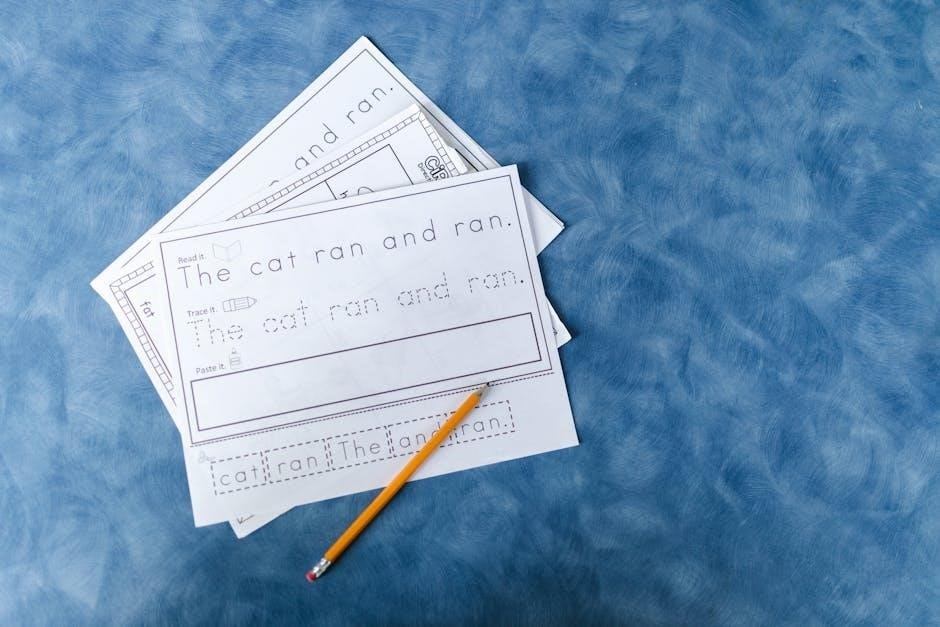
Common exercises include tracing activities, where students follow dotted lines to correctly form each letter, building fine motor skills alongside literacy.
Copywork is another effective method, requiring students to carefully rewrite sight words multiple times, promoting muscle memory and accurate spelling.
Worksheets may also feature fill-in-the-blank sentences, prompting students to recall and write sight words in context.
More challenging options include dictation exercises, where a teacher or parent reads the words aloud for students to write. These printable PDF resources are crucial for developing spelling fluency and handwriting skills.
Worksheets for Sentence Building with Sight Words
Sight word sentence building worksheets elevate learning beyond isolated word recognition, fostering comprehension and grammatical understanding. These printable PDF resources challenge students to apply their knowledge in a meaningful context.
Typical exercises involve providing a set of sight words and prompting students to arrange them into grammatically correct sentences.
Worksheets often include sentence starters, offering a partial sentence and requiring students to complete it using provided sight words.
Another approach involves scrambled sentences, where students must rearrange jumbled words to form a coherent thought.
More advanced worksheets may ask students to write their own sentences using a specified list of sight words, encouraging creativity and reinforcing proper sentence structure. This builds confidence and fluency.
Sight Word Games & Activities (Printable PDFs)
Sight word games and activities, available as printable PDFs, transform learning into an enjoyable experience, boosting engagement and retention. These resources move beyond traditional worksheets, offering dynamic ways to practice recognition.
Popular options include sight word bingo, where students mark off recognized words on a card as they are called out. Memory match games challenge students to pair identical sight words, strengthening recall.
Word searches cleverly conceal sight words within a grid, encouraging focused scanning and identification. Crossword puzzles provide a more complex challenge, requiring students to use sight words as clues.
Many PDFs offer cut-and-paste activities, like creating sight word books or matching words to pictures. These hands-on approaches cater to diverse learning styles, making practice fun and effective.
Finding and Downloading Sight Words Worksheets PDF
Numerous online resources offer sight words worksheets PDF, ranging from free printable options to comprehensive, paid collections designed for varied learning needs.
Free Printable Sight Words Worksheets
A wealth of free printable sight words worksheets are readily available online, offering accessible resources for parents and educators alike. Websites dedicated to educational materials frequently host these resources, categorized by Dolch or Fry lists and skill level.
These worksheets often include activities like tracing, matching, sentence completion, and word searches, designed to reinforce recognition and usage. Many sites allow filtering by grade level (Pre-Primer to Grade Three) or specific word sets, streamlining the search process.
Popular platforms provide downloadable PDFs, easily integrated into lesson plans or home practice routines. While quality varies, a diligent search yields effective materials. Remember to preview worksheets to ensure alignment with your child’s learning objectives and curriculum. Utilizing these free resources can significantly support early literacy development without financial burden.
Paid Sight Words Worksheet Resources
While numerous free options exist, paid sight words worksheet resources often provide a more comprehensive and professionally designed learning experience. Platforms like Teachers Pay Teachers host a vast collection created by educators, offering diverse activities beyond basic tracing and matching.
These resources frequently include themed units, interactive games, and differentiated instruction materials catering to varied learning styles. Bundles encompassing entire grade levels or specific word lists are common, offering substantial value. Paid worksheets often boast higher quality graphics and more detailed answer keys.
Investing in these resources can save valuable preparation time for teachers and parents. They frequently align with specific curricula and offer assessment tools to track progress. Consider paid options for specialized needs or when seeking a more structured and engaging learning program.